The son of three nations /Melikov G. G. - 2001/
Скачать: Melikov G. G. - The son of three nations - 2001.pdf
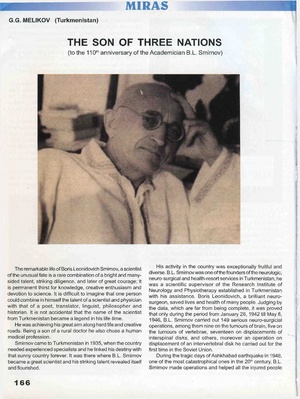
The remarkable life of Boris Leonidovich Smirnov, a scientist of the unusual fate is a rare combination of a bright and many-sided talent, striking diligence, and later of great courage; it is permanent thirst for knowledge, creative enthusiasm and devotion to science. It is difficult to imagine that one person could combine in himself the talent of a scientist and physician with that of a poet, translator, linguist, philosopher and historian. It is not accidental that the name of the scientist from Turkmenistan became a legend in his life-time.
He was achieving his great aim along hard life and creative roads. Being a son of a rural doctor he also chose a human medical profession.
Smirnov came to Turkmenistan in 1935, when the country needed experienced specialists and he linked his destiny with that sunny country forever. It was there where B. L. Smirnov became a great scientist and his striking talent revealed itself and flourished.
His activity in the country was exceptionally fruitful and diverse. B. L. Smirnov was one of the founders of the neurologic, neuro-surgical and health-resort services in Turkmenistan, he was a scientific supervisor of the Research Institute of Neurology and Physiotherapy established in Turkmenistan with his assistance. Boris Leonidovich, a brilliant neurosurgeon, saved lives and health of many people. Judging by the data, which are far from being complete, it was proved that only during the period from January 28, 1942 till May 8, 1946, B. L. Smirnov carried out 149 serious neuro-surgicial operations, among them nine on the tumours of brain, five on the tumours of vertebrae, seventeen on displacements of interspinal disks, and others, moreover an operation on displacement of an intervertebral disk he carried out for the first time in the Soviet Union.
During the tragic days of Ashkhabad earthquake in 1948, one of the most catastrophical ones in the 20th century, B. L. Smirnov made operations and helped all the injured people
under the external conditions in the open air, not thinking about the time. A large square in the centre of the city was a kind of operating-room.
In the scientific heritage of B. L. Smirnov — physician, there are seventy four scientific works, three of them were published abroad in the leading journals.
A great service of the scientist is his training of specialists for the country. Fifteen scientific theses were written and defended under his supervision; a great number of scientific works dealing with the topical problems of the neuropathology were published.
It is notable that being Head of the Department of Nervous Diseases B. L. Smirnov was one of the first in the former Soviet Union to introduce lectures on neuro-surgery into the course of neurology for the students of the Turkmen State Medical Institute.
Indian studies are one of the hypostases of his great talent. For many years he was maturing his impertinent project — to translate Mahabharata, a pearl of ancient Indian literature, from the language of the original into Russian. The story of his work on that outstanding literary monument of the Indian people is an exciting page of inflexibility of the human spirit and his great devotion to literature. He devoted all the palette of his great and kind talent and long years of his life to the work on the great ancient Indian epos. Being a young man he showed his outstanding gift for foreign languages and learned many European languages. Later it so happened that he got interested in Sanskrit, a language of ancient India.
From 1918, when Boris Leonidovich took the dictionary of the Sanskrit language into his hands for the first time and till his retirement in 1956, side by side with his great and multiform work in medicine he found the time for independent study of Sanskrit and literature in the history and philosophy of India and worked on the translation. In 1956 after his retirement because of serious heart disease B. L. Smirnov entirely devoted himself to the work on Mahabharata. Being a doctor, he clearly understood that his life had left him so little time to live. And Boris Leonidovich hurried. A delicate, breaking thread of life became weaker from year to year, and he was bed-ridden by his serious aliment, but he kept on working selflessly on the translation. When his weak hand could not hold pen any more. Boris Leonidovich began dictating the text and his wife, friend and unalterable assistant, Lyudmila Erastovna wrote down the translation.
One of the first translators of Mahabharata into Russian, Berg was sure that the European languages were not able to render the whole beauty of the original in translation. The scientist from Turkmenistan disproved that opinion. In his translation he used an innovation principle of presenting an epos expressed in free verse. The way to that decision was long and not easy — it was preceded by the work of many years, meditations and search. At first his translations were not perfect enough. Boris Leonidovich has made sixteen variants of translation. It was a titanic work, but none of them satisfied an exacting scientist. Some important element was missing. But what? Suddenly it dawned on him. The case had helped him. One day Boris Leonidovich was listening a radio programme from India — singing was performed in Sanskrit and was dedicated to the next anniversary of the death of Ghandi. And for that short time Smirnov felt the spirit of Sanskrit, perceived the spirit of the original of Mahabharata. In that new key he had made the last, seventeenth, the most successful, translation of that immortal literary monument. It was a victory, a victory of the rare talent multiplied by great diligence.
In all B. L. Smirnov translated and prepared for publication eight issues of Mahabharata, seven of them were published in his life-time. The scale of the work done by Smirnov produces a great impression: he translated about 23,000 shloks (couplets) from 100,000 ones composing that great epos.
It is difficult to overestimate the significance of that unique work that became the highest point of the art of translation. Its eternal value is that it has opened a powerful layer of the ancient Indian culture for millions of people.
Of great importance are long and interesting prefaces to the translated volumes of Mahabharata, his historical and literary comments, which, in the specialists' opinion, can be put in the same rank with independent peculiar monographs due to the richness of the material used in them and deep research. Besides, high and all-round erudition of B. L. Smirnov, a linguist, philosopher and historian, revealed itself in that.
The specialists highly appreciated the translations made by B. L. Smirnov which were marked by innovation, high scientific honesty, care of the original, perfection and beauty of the poetic form and great artistic merits.
The translations made by the scientist and physician from Ashkhabad became a real event in the scientific world of the Orientalists; it was a real sensation. It is really so because nobody suspected that in far provincial Ashkhabad there lived a person who dared to translate that great book. Only the list of the leading scientific journals published reviews of the publication of some volumes of Mahabharata testified to much (Bulletin of the History of the World Culture, Courier of UNESCO, Soviet Oriental Studies and Contemporary Orient). Many prominent scientists from Moscow and Leningrad wrote to him. And all the letters had a high appreciation of the talented and original work of B. L. Smirnov and admiration of his rare talent.
E. A. Makayev, the Professor of MSU, a specialist in Sanskrit, noted, “I am surprised how distinctly, correctly and poetically irreproachably you feel the spirit of the original. We all admire you courage and selfless devotion to science and scientific activity”.
The Deputy Director of the Institute of the Oriental Studies of the USSR Academy of Sciences R.Ya.Ulyanovsky wrote stressing titanic work and scales of the scientist’s work, “that titanic work could be done only by all the workers of the Institute”.
During the years of independence the President of Turkmenistan Saparmurat Turkmenbashi the Great especially marked the outstanding work of B. L. Smirnov, admiring his translation as a brilliant one. The President of Turkmenistan had not appreciated any of the native scientists so high.
The scales of the activity of Boris Leonidovich in the sphere of Indian studies created an unusual precedent. It will not be an exaggeration to say that from 1955 till 1967 the works of B. L. Smirnov made Ashkhabad one of the famous centres of the Indian studies. “Your selfless labour has begun the researches of India in Ashkhabad”, the Academician Gafurov wrote to the scientist from Ashkhabad.
Many admirers of the ancient Indian epos showed their sincere interest in the translations of Mahabharata-. a great number of letters from different regions of the USSR came to Ashkhabad, there were also letters from the foreign countries (Finland, Bulgaria and Poland) with a request to send separate volumes of Mahabharata in translation made by B. L. Smirnov. The name of B. L. Smirnov and the great ancient Indian epos entered the consciousness of the readers as unique items.
The public of India took the brilliant translations of Mahabharata into Russian with a feeling of great satisfaction, paying a tribute of deep respect and admiration to the author of the translation. Exciting letters came to B. L. Smirnov from far India. Balmukund Mishra, an Indian writer and journalist, wrote to B. L. Smirnov, “The scientists of my country look at you with deep anxiety and respect and admire your great work. We bend our heads in reverence when we listen to, read and observe your nice artistic and literary works, trembling with life, charming and inspiring. Your visit to India would be cordially greeted and it would be a source of great happiness and joy for all of us”.
The Vice-President of India S. Radkhakrishnan sent a short letter to B.L.Smirnov in which he expressed his gratitude for sending him a copy of Bhagavadgita in the translation made by B. L. Smirnov.
To show his great respect for B. L. Smirnov the President of the Indian nad Soviet Cultural Association Krishna Menon and his wife, a scientist and specialist in Sanskrit studies, came to see Smirnov while their visit to Ashkhabad and during their talk they expressed their gratitude to Smirnov for his work, great and selfless, which assisted cultural rapprochement of the nations. Inviting B. L. Smirnov to visit India Krishna Menon said the following words, “People and government of India highly appreciate your contribution to Indian culture. We shall welcome you in our country in the way we honour only Neru”.
In India none of the foreign scientist was favoured with such great words and honour.
In 1966 B. L. Smirnov received another invitation to visit India, that invitation was sent by the Minister of Education of India Shri Chagla. Boris Leonidovich himself dreamed to foot on the land of that far and beautiful country to meet and talk with the Indian scientists. But it was already impossible: his life was slowly dying. On May 2, 1967 he died.
A character sketch of the great scientist will not be complete if we do not mention his personal human characteristics unknown to the public. Being a man of high culture and intellegence, notable for his modesty, devoted to the principles of humanism and high morality, he despised double-faced morality and insincerity, he was far from pseudoscientific passions. During all his life he confessed the cult of service to the people, real values, triumph of the truth and priority of justice. By rights great and common words on his grave crowned his main life credo — “There is no higher law than the truth”.
B. L. Smirnov rightfully belongs to those remarkable galaxy of the outstanding men of science and culture of Turkmenistan, who are its pride and glory, its golden fund.
The Academician Boris Leonidovich Smirnov, an extraordinary man of unusual fate and bright talent, outstanding scientist and physician, Professor, neuropathologist and neurosurgeon, teacher, outstanding specialist in Indian studies, a member of the Writers’ Union, Honoured Scientist of Turkmenistan, has lived nice and selfless life that became a legend; he made a great and invaluable contribution to the human culture, to a great cause of friendship and brotherhood among the nations.
